


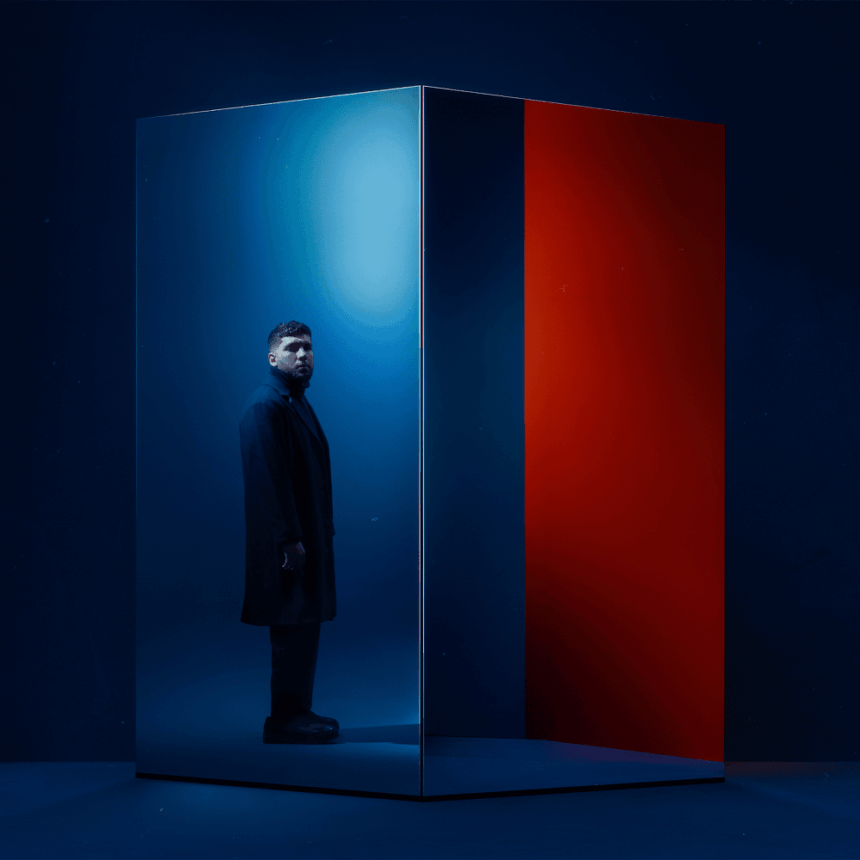
From the very first teaser campaign surrounding Lege-Cy’s latest album, Placebo, audiences were drawn in by the excitement and curiosity of discovering a project that felt tightly conceptual, unified, and deliberate in its vision. The album’s striking cover leans into a cinematic sensibility, placing Lege-Cy inside a glass room split in two, one half red, the other blue, instantly prompting listeners to wonder about the story behind the record and the artistic statement it was trying to make.
The rollout revealed that the album would unfold across three chapters, with each section arriving on a different date over the course of three weeks. That release strategy created a strong sense of anticipation around the project and suggested a carefully structured body of work rather than a casual drop.
A placebo, by definition, is a substance with no real therapeutic value, yet one that can still trigger physical or psychological improvement. In the context of Lege-Cy’s artistic evolution, the term carries particular weight. It naturally recalls his earlier release, Agzakhana, which explored a related medical theme through track titles like “Betadine,” “Kommadat,” and “Roshetta.” With Placebo, that conceptual thread returns in a more developed and layered form.
The album presents what feels like a personal journey of growth, and its title seems like a logical continuation of Lege-Cy’s larger artistic arc, one that explores the power of music as a vehicle for transformation. In that sense, his artistic persona appears to undergo a positive shift here, as though Placebo reflects the metaphorical healing first introduced in Agzakhana.
The sound of transformation
The album opens with “Bekam,” a track that immediately establishes an echo-heavy atmosphere, using vocal and sonic textures that create an immersive and emotionally charged soundscape. Lege-Cy’s voice moves fluidly through autotune, reverb, and delay, all handled with precision. He transitions seamlessly into the next track through a similar sonic structure and recurring melodic motif, before the song develops midway with a tightly constructed verse laid over crisp drum patterns.
Lege-Cy maintains the signature vocal identity he has been shaping for some time now, balancing rap and R&B with impressive control. He often leans on electric guitar and violin samples as the backbone of his production, while delicate drum programming leaves enough room for his voice to remain central. That approach comes through clearly on “Tripod,” which opens with a soft hum that gradually fades into a faster kick pattern. The beat then settles into a calmer mode, with a guitar sample acting as the track’s foundation while Lege-Cy delivers short bars that feel intentionally fragmented and open-ended.

The first chapter reveals some of the album’s standout moments, especially with the arrival of “Zero F,” which rides on a calm, dreamlike tone while Lege-Cy delivers sharp lines with refined technique: “Omry دماغي دي ما صدت / Omr دماغك دي ما صدت.”
A cohesive sonic world
As the second chapter unfolds, the album offers even more carefully produced and genuinely enjoyable melodies, highlighting Lege-Cy’s development as an artist and reinforcing the strength of his aesthetic. Production stands as one of the album’s clearest strengths, with rich electronic textures layered throughout in a way that emphasizes his growth and deepens the sonic identity of the record.
Collaborations with Bully Braah and Toul8te add to the album’s sonic cohesion, reinforcing its sense of direction through carefully chosen textures and arrangements. The production gives the music ample room to breathe without ever allowing Lege-Cy’s voice to fade into the background, as heard on “Copy Cats,” where he takes a commanding role within the track.
Toul8te, meanwhile, brings a surge of energy to the song he appears on, arriving over a heavy beat with a distinctive vocal presence that injects the track with urgency and fire. The production pushes Lege-Cy to rise to that energy, and he responds with a strong verse that showcases his technical command.
Measured experimentation
Around the middle of the album, however, it becomes clear that Lege-Cy is only experimenting within measured limits, as the project does not offer a great deal of surprise on a sonic level. Most of the experimentation lies in the unconventional structure of certain tracks, such as “Placebo,” which revolves around a repeated chorus floating over a synth-heavy, immersive instrumental bed.
The movement between shades of blue and red in the album’s visual identity mirrors the emotional and musical shifts taking place throughout the record. While the album may have benefited from a different sequencing to better serve its themes, it still succeeds in reaffirming Lege-Cy’s artistic language and deepening his imprint on the scene.